The Evolution of Continuing Airworthiness: Why the Transatlantic Gap is Narrowing
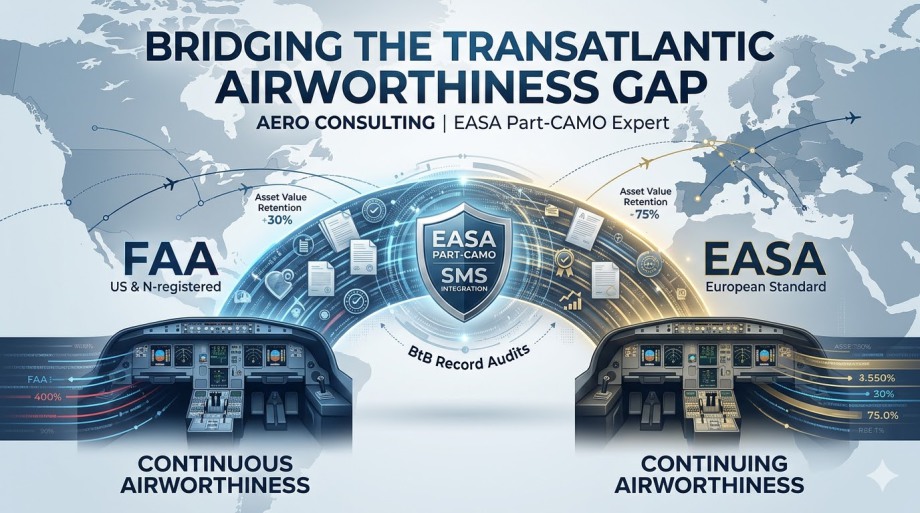
As we navigate through 2026, the aviation industry is witnessing a significant shift in how aircraft assets are managed across borders. With the resurgence of transatlantic fleet movements and the increasing complexity of lease returns, the "technical gap" between FAA and EASA jurisdictions has moved from a back-office concern to a boardroom priority.
While the Bilateral Aviation Safety Agreements (BASA) have laid the groundwork for cooperation, the operational reality on the ground—especially regarding EASA Part-CAMO requirements—remains a formidable challenge for international operators. At Aero Consulting, we have observed that the most successful transitions aren't just about moving an aircraft; they are about the seamless synchronization of two very different regulatory philosophies: the American Continuous Airworthiness and the European Continuing Airworthiness.
In this deep dive, we explore why "compliance" has become a strategic asset class and how bridging the FAA-EASA divide is essential for maintaining both safety and residual value in today’s volatile market.
By Aero Consulting
In the global aviation market, an aircraft is more than a machine; it is a financial instrument. Yet, for many US-based operators and international lessors, the "Atlantic divide" between FAA Continuous Airworthiness and EASA Continuing Airworthiness remains a source of significant friction, delays, and unexpected costs.
As we move further into 2026, the regulatory landscape has evolved. Compliance is no longer a back-office administrative task—it has become a critical component of asset valuation.
From CAMP to CAMO: A Strategic Translation
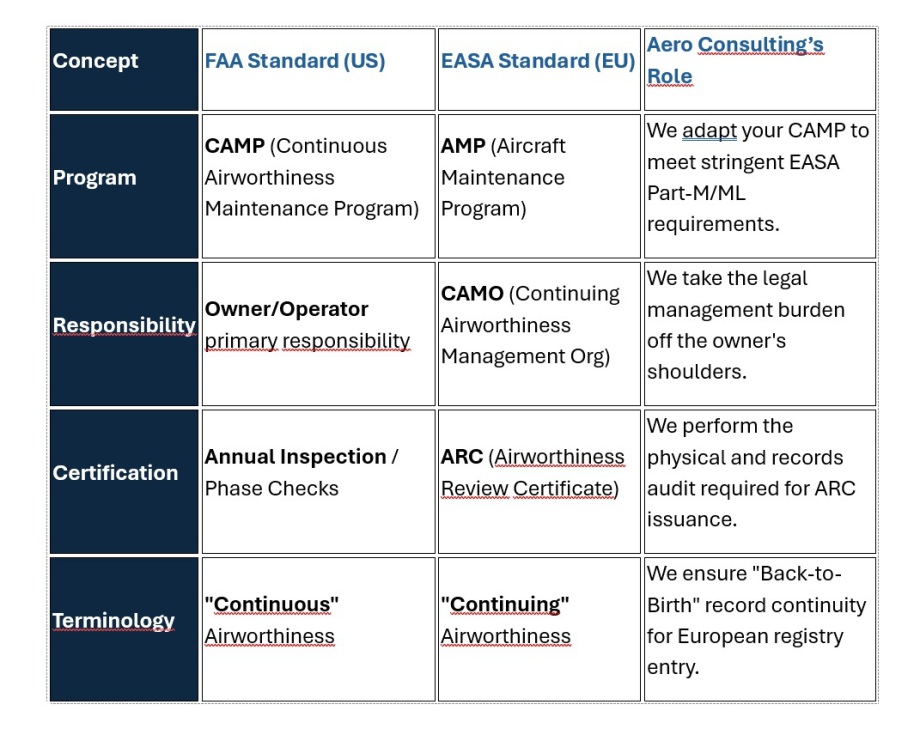
For an American operator under Part 121 or 135, airworthiness is managed through a CAMP (Continuous Airworthiness Maintenance Program). The responsibility is centralized.
However, crossing into EASA territory introduces the CAMO (Continuing Airworthiness Management Organization). Under Regulation (EU) 2019/1383, the CAMO is not just a service provider; it is the legal guardian of the aircraft’s airworthiness. For a US firm, failing to understand this distinction doesn't just mean "more paperwork"—it means risking the validity of the Airworthiness Review Certificate (ARC) and, by extension, the asset's ability to fly or be traded in Europe.
The $100,000 Signature: The "Back-to-Birth" Challenge
At Aero Consulting, we often see high-value transitions stall during the records audit. The FAA and EASA have a Bilateral Aviation Safety Agreement (BASA), but the "devil is in the data."
EASA’s stringent requirements for Back-to-Birth (BtB) traceability on Life Limited Parts (LLP) and AD compliance often exceed what is standard practice in other registries. Our role is to act as a Technical Bridge. We don't just audit; we reconstruct and validate data sets to ensure that when an aircraft moves from an N-registry to an EASA state, its residual value remains intact.
2026: The Year of Mandatory SMS in CAMO
The recent integration of Safety Management Systems (SMS) into the Part-CAMO environment has fundamentally changed the game.
International firms now need a partner who can navigate:
-
Occurrence Reporting: Aligning US safety cultures with EASA’s "Just Culture" mandates.
-
Risk Assessment: Identifying latent maintenance risks before they become AOG (Aircraft on Ground) statistics.
-
Data-Driven Reliability: Using advanced analytics to optimize Maintenance Programs (AMP) and reduce operational overhead.
Why Aero Consulting?
Based in the heart of the European aerospace ecosystem, Aero Consulting provides the specialized oversight that global firms require but often lack internally when dealing with EASA.
We offer:
-
Strategic Advisory: Managing the complex "import/export" of aircraft between FAA and EASA jurisdictions.
-
Expert Auditing: High-stakes records reviews for lessors and hedge funds.
-
Full CAMO Support: Taking the legal and technical burden off the owner-operator.
In aviation, the most expensive component is a piece of paper that isn't signed correctly. In an era of tightening margins and increasing scrutiny, Aero Consulting ensures that your fleet remains a high-performing asset, regardless of which side of the Atlantic it calls home.

For a detailed technical breakdown of our FAA-EASA bridge services, visit our dedicated US Compliance Portal.
 Version imprimable
Plan du site
Version imprimable
Plan du site
© AERO CONSULTING Formations Aéronautiques France, Europe, USA, Afrique, Océanie - Formations en présentiel, en ligne, en visio, à distance,blended, en e-learning - Expertise, Formation et conseils dans l'aéronautique, l'aéroportuaire et l'industrie du transport aérien - Sécurité aéronautique - Ateliers part 145 et maintenance aéronautique - Conformité aéronautique (EASA EU Ed 2021/1963) - Conformity Monitoring and Safety Management Systems - Compliance with the New Regulation PART 21, PART 145, PART CAMO - EASA FH PART 145 SGS / SMS, Manuels d'exploitation - CRM, SGS - FTS - CAMO - FOD - LOSA - MMEL & MEL - AVI - PER - DGR - PART 21 G et J - Elearning - Florida Aviation - Florida Aviation Compliance, EASA & BASA/MAG; Maintenance Training - CAMO, MRO - Pilot Training, Aviation Partnerships in Florida, FAA–EASA Dual Approval
